Infrastructure
Blue Ocean Strategy Explained: Create, Don't Join Fights
Most startups die fighting in red oceans. Blue Ocean Strategy is the lens we use to pick ideas worth building, explained with the Nintendo Wii.
Walk into any coworking space in Saigon on a Tuesday night and you'll meet three founders building slightly different versions of the same startup. A food delivery app with better UX. A B2B SaaS that's Notion for one niche. A fintech that's almost exactly a competitor with "local nuance." Beautiful decks. Reasonable traction. Most will be dead in two years.
Not because they're bad founders. Because they're fighting in a red ocean, and red oceans kill almost everyone.
Blue Ocean Strategy, by W. Chan Kim and Renée Mauborgne (INSEAD), is the lens we apply before we agree to validate any idea. If an idea is a better version of an existing fight, we walk, no matter how good the unit economics look.
Two oceans
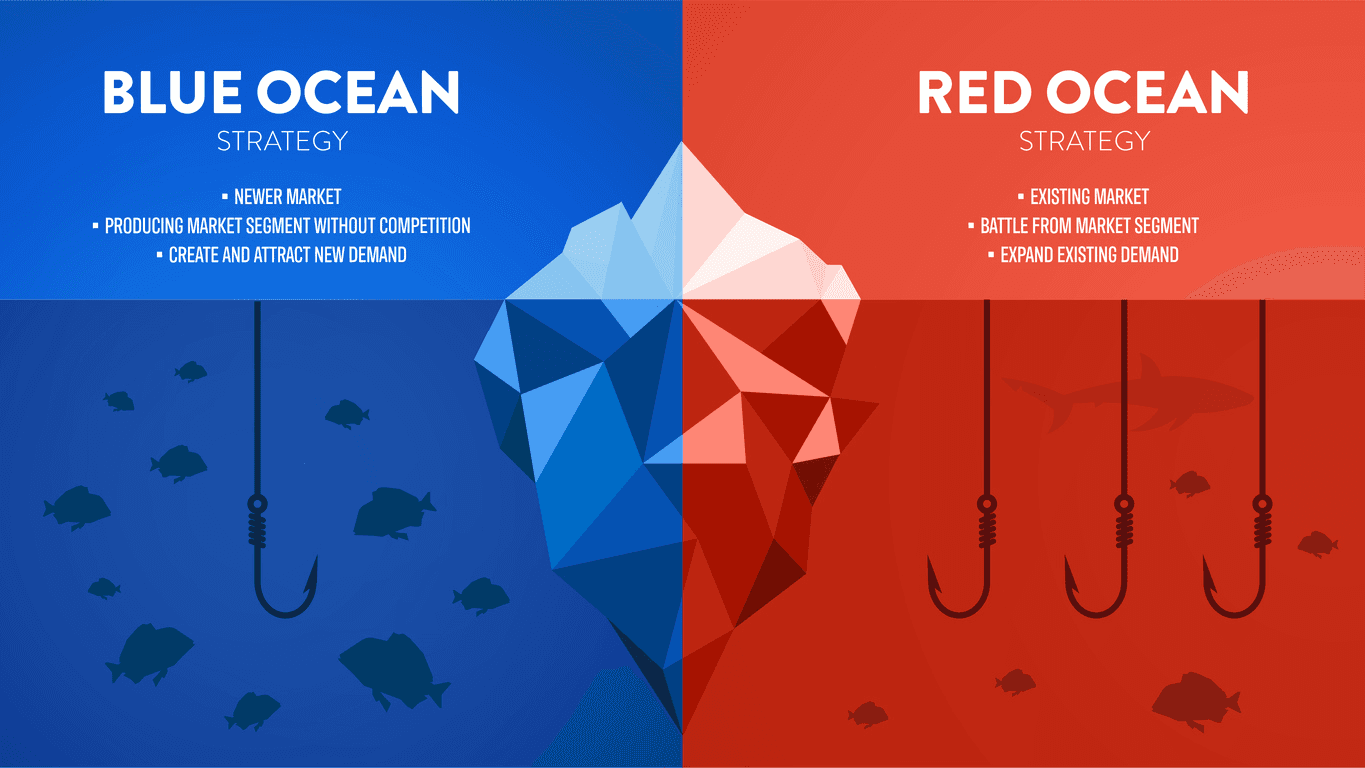
The red ocean is every industry that exists today. Boundaries drawn. Rules understood. Companies chase a bigger slice of existing demand. As the space fills, margins compress and competition turns the water bloody. Most startups are born here, and most die here.
The blue ocean is a market that doesn't exist yet. Demand isn't fought over, it's created. Growth is fast and profitable because no one else is competing for the same customer. Companies that create blue oceans typically enjoy 10 to 15 years before rivals catch up.
Two paths in: invent a new industry outright (eBay → online auctions), or redraw an existing industry's boundaries so completely it becomes a new category (Cirque du Soleil = circus + theater; Apple = hardware + software + design). They look strange before they look obvious.
What we hunt for
Inside our three sectors, we're not looking for "a better X." We're looking for one of three shapes:
Problems being overlooked: usually because they're unglamorous, unprofitable on paper, or served by an incumbent that stopped paying attention.
Customers nobody designs for: usually invisible in the personas investors look for.
Rules that can be rewritten: pricing models set by accident, distribution channels turned into gatekeepers, assumptions about what the product must include.
If an idea doesn't fit one of these, it's probably a red-ocean fight.
Value Innovation is the engine
The strategic move that opens a blue ocean is Value Innovation. Most businesses treat differentiation and low cost as a trade-off: premium or cheap, pick one. Value Innovation refuses the trade-off. The company builds something simultaneously more valuable to the customer and cheaper to produce, by redesigning the whole business model rather than tweaking the product.
Note: Value Innovation is not "low cost with low quality." That's a race to the bottom. Cheap restaurants with bad service. Budget hotels with stained sheets. Earbuds that work for a week. That's just thin-margin survival.
Real Value Innovation delivers more of what customers actually want and cuts everything they don't care about.
The 4-Actions Framework
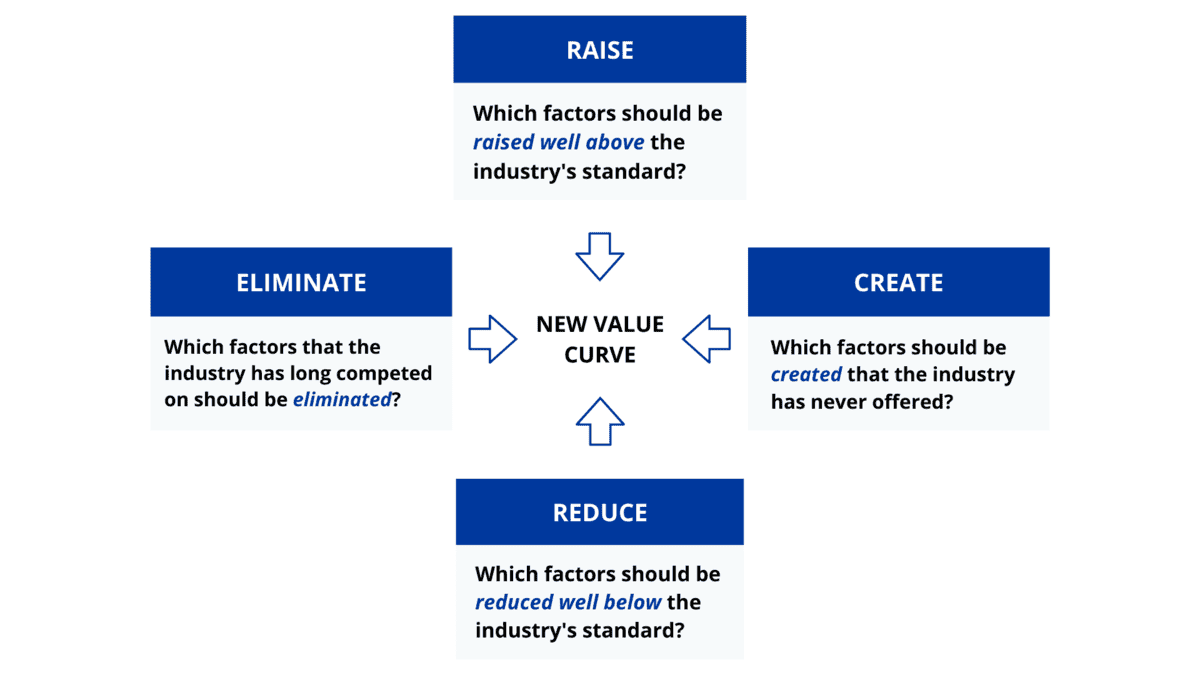
Four questions, applied to the industry as it stands:
What can we Create that the industry has never offered?
What can we Raise above current standards?
What can we Eliminate that the industry has always taken for granted?
What can we Reduce below the industry norm?
Create + Raise generate differentiation. Eliminate + Reduce generate cost advantage. A real blue-ocean play uses all four, and the answers reinforce each other.
Nintendo Wii, in short
Mid-2000s console market: PlayStation and Xbox racing on graphics, processing power, exclusive blockbusters. Sold hardware at a loss to win the install base. Everyone agreed the rules.
Nintendo walked out of that agreement. They targeted casual gamers and non-gamers — a much bigger pond. Built a deliberately inferior machine on dimensions that didn't matter to that audience, and added motion control that did.
In 4-Actions terms:
Created motion control (industry never had it)
Raised fun and accessibility (industry let them atrophy)
Eliminated the hardware-subsidy model (treated as law of nature)
Reduced raw processing power (was buying nothing with the new audience)
Result: not a better Xbox. A different game on a different board for a different audience. That's a blue-ocean company from the inside.
Other classics worth studying
Cirque du Soleil (circus + theater, no animals). Dyson (appliances as aspirational tech). Tesla (luxury-first EV strategy). Apple (hardware, software, services as a single product). CitizenM (cuts the hotel parts modern travelers don't use). The Body Shop (ethical sourcing decades early). Same move, different industries: redraw the boundaries.
Why this matters for OS Research
Our mission: 20 blue-ocean companies in 10 years. Two a year, on average. Twenty chances to redraw a market.
Every time an idea walks in, the first question isn't can this work? It's is this a new game, or a new entrant in an old one? If it's the second, validation can't save it.
The ideas that pass the Blue Ocean check go to the next test: do we actually understand what this customer wants?
← Previous: Building for the Modern Vietnamese Household
→ Next: The Value Proposition Canvas
🏠 Series hub: Inside a Startup Validation Studio